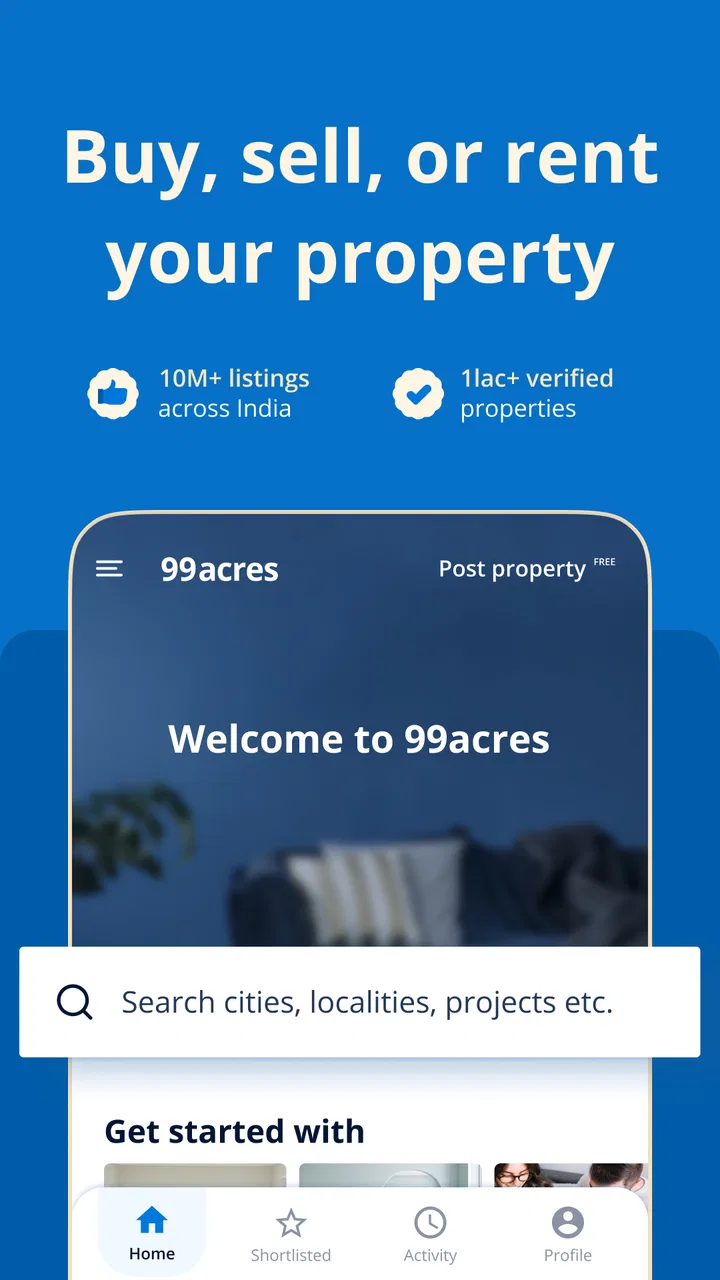
99acres Buy/Rent/Sell Property
- 4.3
- Rating
- 10.00M
- Installs
- Free
- Price

 Analysis by App-foxy
Finding a home in India can feel like a full-time job, especially when you are comparing rent, purchase prices, locations, and the practical details that make one property suitable while another is not. I found 99acres Buy/Rent/Sell Property most useful as a starting point for bringing that search into one place. It is a free House & Home app from infoedge.com, designed for people who want to buy, rent, or sell property through a mobile search experience.
My first impression was that the app is aimed at reducing the early chaos of property hunting. Instead of relying only on newspaper listings, scattered social posts, or repeated conversations with local contacts, I could begin by searching in the areas and price ranges that mattered to me. That does not remove the need for calls, visits, document checks, and negotiation, but it gives the process a more manageable first step.
99acres Buy/Rent/Sell Property has been available since December 17, 2013, and its scale is clear from its audience: it has passed ten million installs and holds an average rating of 4.2 from roughly two hundred thousand ratings. Those figures do not guarantee that every listing will suit every person, but they do suggest that the app is familiar to a large number of property seekers.
You May Also Like

 AccuWeather: Weather Radar
AccuWeather Review: A Quick, Clear Forecast for Everyday Decisions
For everyday plans, the best forecast is the one you can understand quickly. AccuWeather makes rain timing, radar, and local conditions easy to act on, with a few trade-offs.

 Hill Climb Racing
Why Hill Climb Racing Still Turns Crashes Into One More Run
A tiny car, a bumpy hill and one more upgrade: Hill Climb Racing keeps resurfacing because its simple chaos makes every near-miss feel personal.

 AliExpress - Shopping App
AliExpress Makes Global Shopping Feel Personal, but Shoppers Bear the Risk
AliExpress turns a global marketplace into a pocket-sized discovery engine. Its reach is useful, its shopping loop compelling, and its trade-offs easy to miss.

 Lords Mobile: Kingdom Wars
Lords Mobile Is a Kingdom-Building Routine, Not a Quick Match
A case-by-case verdict on the building, battles, device demands, and social commitments that make Lords Mobile rewarding for some players and exhausting for others.

 PDF Scanner app - TapScanner
TapScanner Makes Paperwork Easier to Capture, Check, and Share
TapScanner makes scanning with a phone feel less like a rescue operation and more like a dependable step in getting work done. Its capture tools are useful, though not flawless.

 Block Blast!
 Shows How Much a Puzzle Game Can Leave Out
A quiet grid game shows why puzzle players increasingly value instant clarity, repeatable skill and low-pressure play—and where the genre still needs to catch up.
More From Our News Desk
View All News


What the first search feels like
When I use a property app for the first time, I do not expect it to make the final decision for me. I want it to answer simpler questions quickly: which areas have suitable listings, what kind of homes are available, and whether my expectations match the local market. That is where this app makes the most sense.
The experience is best understood as a discovery and comparison tool rather than a replacement for a property agent, lawyer, landlord, or site visit. A listing can help me decide which homes deserve attention, but it cannot replace checking the building, confirming the address, asking about upkeep, or reviewing the terms carefully. Keeping that distinction in mind makes the app much more useful and prevents unrealistic expectations.
For a first-time renter, the main benefit is having a repeatable way to narrow the search. I can think in terms of location, budget, property type, and whether I need a place immediately or am only researching. For a buyer, the same process helps build a shortlist before spending time on calls and visits. Sellers can approach the app from the opposite direction, using it as a place to put a property in front of people already searching.
The app is suitable for adults and carries an Everyone content rating, which fits its practical purpose. It is also free to use. That makes it easy to install while I am still deciding whether a mobile property search is better for me than browsing through a desktop website or contacting an agent directly.
Setting up a useful search instead of browsing randomly
The most important part of getting started is not the installation itself; it is deciding what I am actually looking for. “A flat in a good area” is too vague to produce a useful shortlist. Before searching, I would write down the preferred locality, the maximum budget, the number of bedrooms, and the features that are truly essential. I would also separate must-haves from nice-to-haves, because property searches become frustrating when every preference is treated as equally important.
For example, someone moving for work might care more about daily travel time than an extra room. A family may prioritize schools, floor space, and a quieter setting. A student or young professional may accept a smaller home if the location makes commuting easier. The app can help surface options, but I still need to decide which trade-offs I am willing to make.
On my first pass, I would avoid setting filters so narrowly that the results become empty or misleading. A slightly wider locality search can reveal nearby neighborhoods that offer better value. I would then compare those results rather than assuming the first area I had in mind was the only sensible choice. This is one of the less obvious advantages of using a structured search: it can challenge an initial assumption about where I need to live.
Another useful habit is to search separately for renting and buying rather than mixing the two ideas mentally. The monthly cost of rent and the total commitment of a purchase answer very different questions. If I am undecided, I would use the app to understand the available properties in both categories, then compare the practical consequences outside the app, including travel, maintenance, deposits, financing, and how long I expect to stay.
Reaching the first meaningful result
A successful first session should end with a small shortlist, not an endless stream of listings. I would begin with a broad search, remove clearly unsuitable properties, and then inspect the remaining options more carefully. The goal is to identify a few homes that are worth contacting or visiting, rather than collecting dozens of possibilities that I will never evaluate.
When I find an interesting listing, I look beyond the attractive headline. I want to know whether the location works for my routine, whether the property type matches my needs, and whether the asking terms fit my actual budget. I also compare similar listings in the same area. That comparison is valuable because it gives me context: a property may look inexpensive until I notice a better-located alternative at a similar cost, or it may seem expensive until I understand what makes it different.
A realistic everyday example would be a person who has received a job offer in a new city and has only a weekend to find a rental. I would use the app before traveling, search near the workplace and along practical commuting routes, and create a shortlist of homes with enough information to plan visits. During the weekend, I could focus on the strongest candidates instead of driving around without a plan. The app would not guarantee a successful lease, but it could make those limited hours far more productive.
For sellers, the first meaningful action is different. The useful outcome is not simply placing a property in front of viewers; it is presenting it clearly enough that the right people can judge whether it deserves attention. Accurate location details, realistic expectations, and clear property information matter more than trying to make a listing sound perfect. A vague or overly optimistic listing may attract attention but waste time for both sides.
My practical tip is to treat every promising listing as a question list. Before contacting the owner or representative, I would note what I need to verify: availability, total cost, furnishing status, access, building condition, and the next step in the process. This keeps a quick search from turning into a confusing series of calls where important details are forgotten.
Where first-time users can get confused
Property terminology and listing presentation can make the first session feel more complicated than it needs to be. A displayed price is not automatically the complete cost of moving in or buying. Depending on the situation, there may be additional practical expenses, conditions, or obligations that need to be discussed directly. I would never treat the first visible figure as the final amount without asking for a complete breakdown.
The same caution applies to location. A listing may appear to be in a familiar area, but the exact street, access route, and distance from daily destinations can change the experience considerably. I would verify the address and visit in person whenever possible. A home that looks convenient on a broad map may be less suitable once I consider traffic, walking conditions, public transport, noise, or the time of day when I normally travel.
Photos also need to be read carefully. They are useful for deciding whether a property is worth further attention, but they are not a substitute for seeing the rooms and surroundings. I look for practical clues such as natural light, storage, ventilation, signs of wear, and whether the images show the whole property or only its most appealing corners. If something important is not visible, I treat that as a prompt to ask, not as evidence that everything is fine.
Another source of friction is listing freshness. Property availability can change quickly, and a home that appears in a search may no longer be available by the time I contact someone. That is not a reason to dismiss the app, but it is a reason to keep several alternatives ready. I would also confirm the current status early in the conversation instead of spending a long time researching a property that has already been taken.
Search results can also encourage unrealistic comparisons. Two homes may look similar on screen while differing in age, building management, parking, surroundings, or maintenance. I try to compare like with like and write down the differences. This simple step prevents the common mistake of choosing a property based only on the lowest visible price.
How I would use it during calls and visits
The app is most effective when it supports the work around the search. I would use the listing details to prepare focused questions before calling. Rather than asking only whether a property is available, I would confirm the points that could change my decision: the exact location, the condition of the home, what is included, the expected timeline, and who is handling the next stage.
For a rental, I would ask about the full move-in requirement and the responsibilities connected with living there. For a purchase, I would move more slowly and treat the app as an initial source of options, not as proof that a transaction is safe or complete. I would independently review ownership, documents, approvals, and legal terms with appropriate professional help before committing money.
For sellers, the app can be useful for understanding how competing properties are presented. I would search similar homes in the same locality and compare how they describe size, condition, location, and pricing. This does not tell me the correct asking price by itself, but it can reveal whether my listing is missing information that prospective buyers or renters need in order to respond seriously.
One trade-off is that a large marketplace can provide breadth while also requiring more filtering. I may see many options, but not all of them will be equally detailed, current, or relevant to my situation. A small local agent may know a neighborhood more personally and may save time for someone who wants guided, offline help. On the other hand, relying only on one agent can limit the range of properties I see. I prefer using the app for broad discovery and then adding local knowledge when I reach the verification stage.
Who will benefit most, and who should look elsewhere
I would recommend this app to first-time renters who need a structured place to begin, people relocating to an unfamiliar city, buyers building an early shortlist, and sellers who want to reach an audience already looking for property. It is especially useful when I am still learning the market and need to compare neighborhoods before making calls.
It is less suitable for someone who expects instant certainty. If I want a guaranteed property, a fully managed rental process, or personal guidance through every legal and financial step, I would look for a specialized professional service as well. Likewise, someone who already has a trusted local agent and a very specific off-market requirement may gain little from browsing a broad marketplace.
I would also avoid using it as the only source for a high-value purchase decision. The app can help me find candidates, but the final decision needs independent checks. That is not a weakness unique to this product; it is simply the nature of online property search. A listing is an invitation to investigate, not a completed inspection.
Performance expectations and practical trade-offs
The current version is 16.0.9 and requires Android 8.0 or later. For someone using a reasonably current Android phone, that makes the app accessible without needing the newest device. Before installing, I would still check the operating system because an older phone may not meet the requirement.
Since the app is free, the main cost is time and attention. I can install it without paying for access, but a serious search still demands careful comparison, follow-up, and verification. This is an important trade-off: the app lowers the barrier to finding options, but it does not eliminate the work required to choose safely.
The rating of 4.2 from about two hundred thousand ratings gives me some confidence that many users find the experience worthwhile, while the presence of roughly six hundred reviews suggests that individual experiences can still vary. I would read recent user feedback if I were troubleshooting a specific issue, but I would judge the app mainly by whether its search results and listing details fit my own location and purpose.
The next step after finding a promising property
Once I have a shortlist, I stop browsing and start verifying. I would contact the relevant person, confirm that the property is still available, and arrange a visit. During that visit, I would check the condition of the home, the surrounding area, access, noise, and anything that could affect daily life. If the property remains suitable, I would request the necessary details and review the agreement or transaction documents carefully.
I would keep notes for every shortlisted property instead of trusting memory. A simple record of location, cost, condition, questions, and follow-up date makes comparisons much clearer. It also helps identify listings that seemed attractive initially but became less convincing after basic checks.
For a rental, I would not transfer money merely because a listing looks convincing or because someone creates urgency. I would make sure I understand who I am dealing with, what the payment is for, and what documentation supports the arrangement. For a purchase, I would be even more deliberate and involve qualified legal or financial professionals where needed.
My overall view is that 99acres Buy/Rent/Sell Property is a practical first step for property discovery in India. I like it most when I use it actively: define my needs, widen the search intelligently, compare similar listings, prepare questions, and verify everything important outside the screen. It is not a shortcut around the difficult parts of renting, buying, or selling, but it can make the early search much more organized.
If you are opening a property app for the first time, I would begin with one realistic goal: find a shortlist that deserves a call. That modest target is more useful than expecting the app to solve the entire move. For me, the free access, broad audience, and focus on buying, renting, and selling make it worth trying, provided I remember that the final decision belongs to careful research, a real visit, and proper checks.
FAQs for 99acres Buy/Rent/Sell Property
01What is 99acres and what services does it offer?
99acres is a comprehensive real estate platform that caters to buying, selling, and renting properties across India. It provides users with access to a vast database of residential and commercial properties, along with detailed insights, market trends, and virtual tours to facilitate informed decision-making.
02Is 99acres available on both Android and iOS devices?
Yes, the 99acres app is available for download on both Android and iOS platforms. Users can easily access the app from the Google Play Store or Apple App Store, ensuring a seamless experience across various devices, whether you're using a smartphone or tablet.
03How user-friendly is the 99acres app for property searches?
The 99acres app is designed with user-friendliness in mind, featuring an intuitive interface that simplifies property searches. Users can filter results by location, property type, budget, and more. The app also offers personalized recommendations and saved search options to enhance the user experience.
04Are there any costs associated with using 99acres?
While browsing properties and using basic features of the 99acres app is free, some advanced services may incur charges. These can include premium listings, featured ads, and other promotional tools for sellers and brokers looking to enhance their visibility on the platform.
05How reliable is the information provided on 99acres?
99acres strives to offer accurate and up-to-date information by collaborating with verified property owners, builders, and real estate agents. However, users are encouraged to perform their own due diligence and verify details independently before making any real estate decisions.
Pros
- Extensive property listings available.
- User-friendly interface for easy navigation.
- Advanced search filters for precise results.
- Detailed property information provided.
- Regular updates with new property listings.
Cons
- Limited offline functionality available.
- Some listings may lack updated photos.
- Requires stable internet for smooth use.
- In-app notifications can be overwhelming.
- Occasional slow loading times reported.

99acres Buy/Rent/Sell Property
Gallery